Why Stress Can Stay in Your Body After the Stressful Thing Is Over
The calendar can say the stressful thing is finished while the body is still responding. Recovery has its own time course — and transitions can help.
Stress is not a substance trapped in your tissues. What happens is that the systems involved in responding and recovering do not change state at the moment the calendar says a demand is over. Recovery has its own time course, and it is extended by unclear endings, rumination, interrupted action, similar cues and existing load. Short transitions — marking the end, orienting to the present, moving, exhaling, re-entering through a value — give the body evidence that this moment is different.
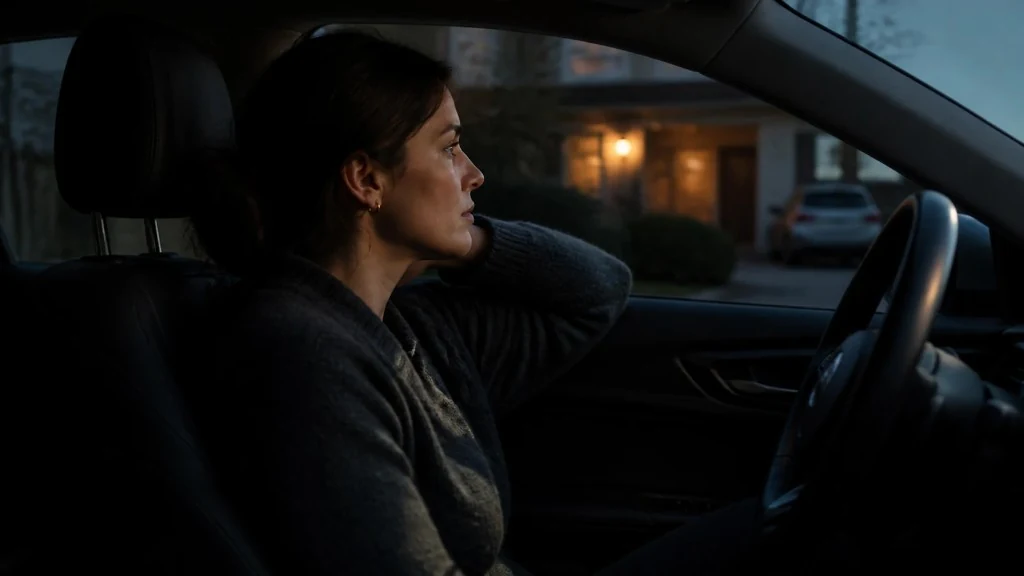
The call has ended. The car is parked. The children are finally asleep. The difficult email has been sent.
Yet your shoulders are still at your ears. You replay the conversation in the shower. A small noise makes you snap. You lie down and discover that the workday is still happening inside you.
The event ended. The response has not caught up.
This does not mean stress is a substance physically trapped in your tissues. It means the systems involved in responding and recovering do not change state at the exact moment the calendar says a demand is over.
A stress response has a recovery phase
When something feels demanding or threatening, the body coordinates changes across attention, heart rate, blood pressure, hormones, muscle readiness and behaviour. These changes are adaptive when they mobilise efficiently and wind down when no longer needed.
Recovery is not an on/off switch. Different parts of the response have different time courses, and people vary. You may know consciously that the meeting ended while your muscles, breathing and attention remain organised around readiness.
Researchers increasingly study not only how strongly people react to stress, but how long responses persist. Prolonged or inflexible recovery can matter as much as the initial reaction.
None of this makes activation itself a problem — a responsive nervous system is a healthy one. The question is whether the response can wind down.
Why the body may keep responding
The ending was not clear
Modern stressors rarely finish with a clean signal. One meeting blends into the next. The argument stops because someone leaves, not because anything feels resolved. Work continues through notifications at home.
Without a transition, the body receives little new information that this moment is different from the last one.
Your mind keeps representing the stressor
Worry and rumination can extend the physiological life of an event. A large meta-analysis linked perseverative cognition — repeated worry or rumination about past or future threats — with changes across heart rate, blood pressure, cortisol and heart-rate variability.
This is not "all in your head". Thought is part of physiology. Replaying the event can keep attention and body readiness pointed towards it.
Action was interrupted
The body prepared to speak, run, push back or solve something, but social rules required stillness. That unfinished readiness may show up as pacing, clenched hands or restless energy afterwards.
Movement will not magically purge a chemical store, but it can give mobilisation an organised, present-day action and help attention shift.
The next cue looks like the last one
A notification sound, tone of voice or room can keep prompting the same prediction. Even if the original event is over, related cues continue to arrive.
The system is already carrying load
Poor sleep, pain, illness, sustained uncertainty and repeated demands can slow recovery. When baseline resources are low, the next stressor begins before the last response has fully settled. This is one of the clearest ways your window of tolerance narrows.
A transition is a message: that was then, this is now
Transitions do not need to be long or ceremonial. Their job is to mark an ending, update the senses and choose what comes next.
Try the following sequence after an argument, meeting, commute, school run or social event.
1. Mark the end
Use a concrete action:
- close the laptop and put it away
- write the next task down
- wash your hands
- change clothes
- step through a doorway and pause
Say quietly: "That part is finished for now." You are not claiming the issue is solved. You are naming the boundary around this moment.
2. Find the present environment
Look slowly around. Notice the light, temperature and distance. Find three signs that you are in a different place or time.
For example: "The call is over. I am in the kitchen. It is evening. I can hear the fan."
3. Let the body complete a simple action
Walk around the block, push into a wall, stretch with effort, shake out your hands or carry something light from one place to another.
Choose movement that leaves you more organised, not depleted.
4. Make the exhale easy
If breath focus is comfortable, let three or four exhales become slightly slower. Do not take huge breaths or force a count. If internal focus is not helpful, hum, sigh naturally or stay with external sensation.
5. Re-enter through one value
Ask: "Who or what do I want to meet now?"
Perhaps you want to greet your family before discussing logistics. Eat before opening another screen. Sit in silence before responding. The transition ends by returning to life, not by monitoring your nervous system indefinitely.
A one-minute threshold practice for the end of work
Before entering home — or before shifting from work mode in the same room:
- Name one unfinished task and where it will live until tomorrow.
- Feel both feet and look towards the place you are about to enter.
- Roll the shoulders or press the hands together for five seconds, then release.
- Let one unforced exhale finish.
- Choose your first home action: greet, change clothes, drink water or take two quiet minutes.
The goal is not to become serene in the driveway. It is to avoid carrying the last room into the next one without noticing.
What if the stress returns?
Recovery is rarely linear. The conversation may reappear in your mind. Your body may settle and tighten again.
Do not treat that as failure. Re-orient. Write down what actually requires action. If there is a real unresolved problem, make a plan or set a boundary. Regulation is not a substitute for addressing the stressor.
If the replay is repetitive but not useful, gently label it: "My mind is keeping this active." Return to present sensation or a concrete task. For persistent rumination, trauma reactions or sleep disruption, professional support can help.
And if the same reaction keeps arriving despite your understanding of it, that gap has its own explanation.
Give the day somewhere to end
The stressful thing being over is external information. A transition helps make that ending sensory, behavioural and relational too.
Close something. Look around. Move. Exhale. Re-enter.
You are not forcing the body to forget. You are giving it evidence that this moment is different — and a route back to what matters now.
Frequently asked questions
Why does stress stay in your body after the event is over?
Because recovery has its own time course. The systems involved in responding — attention, heart rate, hormones, muscle readiness — do not all change state at the moment a demand ends. You can know consciously that the meeting finished while your body remains organised around readiness.
Is stress actually stored in the body?
Not as a substance trapped in tissue. That phrasing is a metaphor. What is happening is that the systems involved in responding and recovering do not switch off at the moment the calendar says the demand is over, and several things — rumination, unclear endings, similar cues — can extend that response.
How long does it take to recover from a stress response?
It varies by person and by which part of the response you mean, since different systems have different time courses. Researchers increasingly study how long responses persist rather than only how strongly people react, because prolonged or inflexible recovery can matter as much as the initial reaction.
What is a transition practice?
A short sequence that marks an ending and updates the senses: mark the end with a concrete action, find three signs you are in a different place or time, let the body complete a simple movement, allow a few easier exhales, then re-enter through something you value. It takes about a minute.
Why do I feel tense hours after a difficult conversation?
Common reasons include an unclear ending, replaying the conversation in your mind, interrupted action where your body prepared to respond but social rules required stillness, cues that resemble the original event, and existing load from poor sleep or sustained demands slowing recovery.
References and further reading
- Ottaviani C, Thayer JF, Verkuil B, et al. Physiological concomitants of perseverative cognition: a systematic review and meta-analysis. Psychological Bulletin. 2016.
- Lim CX, Mueller E, O’Brien WH. Perseverative cognition and vagally mediated heart-rate variability: meta-analyses of resting, reactivity and recovery. International Journal of Psychophysiology. 2026.
- Plans D, Morelli D, Sütterlin S, et al. A biofeedback breathing app and post-stress physiological recovery: randomised pilot study. JMIR Formative Research. 2019.
- McEwen BS. Stress- and allostasis-induced brain plasticity. Annual Review of Medicine. 2015.
Soma Circuit is an educational wellness tool. It is not a substitute for professional mental health care, diagnosis or crisis support. If symptoms are persistent, worsening or interfering with daily life, please seek care from a qualified clinician.
If you are in crisis · AU Lifeline 13 11 14 · Beyond Blue 1300 22 4636 · UK Samaritans 116 123 · US 988 · NZ 1737